Looking for a Premiere Pro alternative is usually about more than price. What you are really replacing is the whole workflow around Premiere: timeline habits, export behavior, plugin expectations, and how closely you depend on the rest of Adobe.
That is why some free alternatives look better than they really are in shallow comparison posts. A short-form template editor is not a full Premiere replacement. A professional editor with real limits in its free tier is not a universal answer either.
This guide focuses on what each alternative replaces well.
Preserve the parts of Premiere your work depends on
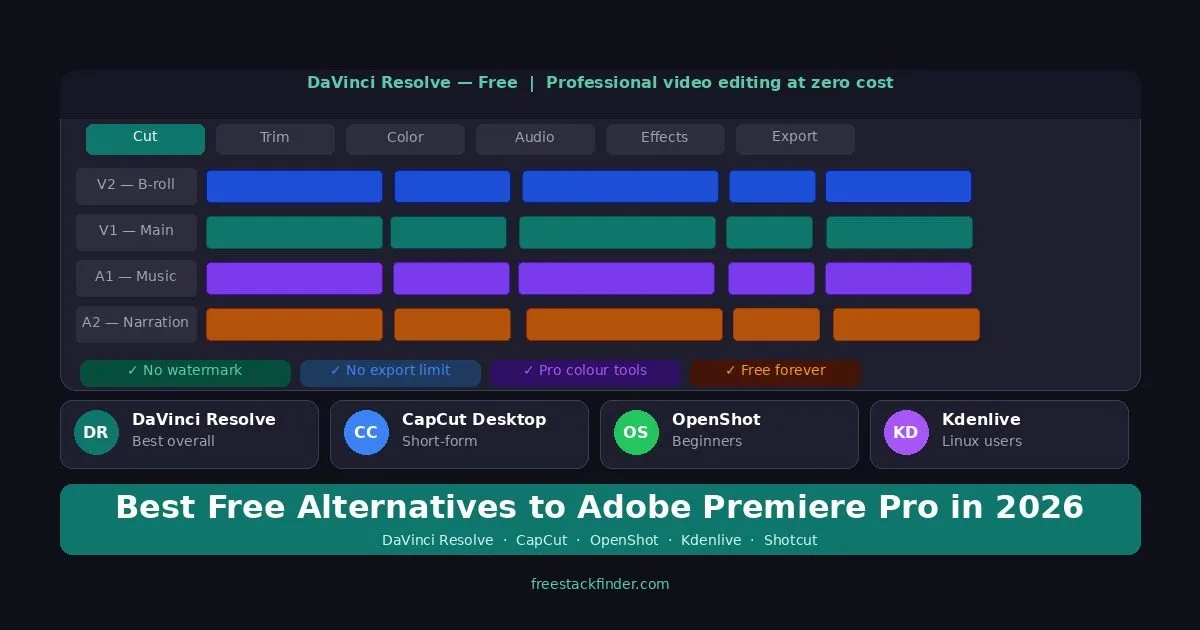
DaVinci Resolve is the first option to test when a solo editor needs timeline, color, audio, and effects tools in one application. Blackmagic frames the free version around common 8-bit formats up to 60fps at Ultra HD 3840 x 2160, while exact codec support varies by platform. CapCut Desktop targets short social output, and Kdenlive provides an open-source multi-track timeline.
Premiere Pro still makes sense if you depend heavily on After Effects, Photoshop handoffs, or large-team Adobe workflows.
Choose by workflow before brand familiarity. Timeline editing depth points to Resolve or Kdenlive. Fast templates, captions, and social exports point to CapCut. Unusual footage points to Shotcut. Professional handoff back into Adobe teams is where staying with Premiere can still be the easier choice.
Project files and plugins raise switching costs
Premiere users often depend on a wider Adobe workflow, including:
- Adobe keyboard habits
- After Effects handoffs
- Creative Cloud asset flow
- shared project conventions
That means a free alternative does not need to be “better than Premiere” in the abstract. It needs to be better for your specific work while keeping switching costs reasonable.
Five editors ordered by Premiere workflow fit
1. DaVinci Resolve: best overall replacement for serious solo editors
DaVinci Resolve is Blackmagic Design’s all-in-one editing, color, audio, and finishing platform.
What the free version includes:
- Full editing timeline
- High-end color tools
- Fairlight audio tools
- Fusion effects workflow
- No watermark exports
What to watch for:
- The free tier is strong, but not limitless
- Blackmagic currently positions it around virtually all 8-bit formats up to 60fps in Ultra HD
- Studio adds more effects, AI tools, and broader support for higher-end footage
Compared with Premiere Pro, DaVinci Resolve makes the most sense when you want a serious solo editing and finishing environment without a monthly Adobe subscription. It fits editors replacing Premiere for YouTube, freelance, documentary, education, and small production work.
The learning curve is real because Resolve is not a Premiere clone. If representative footage imports and exports correctly and the team can absorb the interface change, it can replace much of a solo Premiere workflow.
For a broader ranking of free editors beyond the Premiere question, see our free video editing software guide.
Download DaVinci Resolve free ->
2. CapCut Desktop: best replacement for social-first Premiere users
CapCut Desktop is a fast editor aimed at short-form creators, captions, templates, and platform-ready exports.
What the free version includes:
- Fast timeline editing
- Auto-captions and short-form effects
- Easy desktop and mobile workflow
- Directly useful tools for TikTok, Reels, and Shorts style editing
What to watch for:
- CapCut’s own help pages now make clear that watermark behavior depends on how you build and export
- Standard edits are often clean, but templates, stock assets, or a default outro can add a watermark or attribution requirement
- It is not a true replacement for long-form editorial work
Unlike Premiere Pro, CapCut Desktop is better when the job is speed, captions, templates, and platform-ready social exports rather than long-form editorial control. It fits creators who mainly cut short social videos and do not really need everything Premiere offers.
The trade-off is ceiling. CapCut is not a true replacement for long-form professional handoff, plugin workflows, or complex post-production. But many people who think they need a Premiere replacement need a faster short-form editor, and that is CapCut’s job.
Download CapCut Desktop free ->
3. Kdenlive: best open-source timeline for former Premiere users
Kdenlive is a mature open-source editor with a timeline workflow that feels more conventional than Resolve’s page-based structure.
What the free version includes:
- Multi-track editing
- Proxy workflows
- Audio and color tools
- Strong Linux support and solid cross-platform availability
What to watch for:
- Its interface and workflow are rougher than Premiere or Resolve
- Windows users may still run into rough edges
- It has fewer plugins and learning resources
Compared with Premiere Pro, Kdenlive makes sense when you want a traditional multi-track timeline and open-source licensing more than Adobe’s smoother interface. It fits editors who want a proper editor without Resolve’s heavier post-production structure.
Kdenlive has fewer plugins and learning resources, and its interface is not as smooth as Premiere or Resolve, especially for some Windows users. Still, Kdenlive is the easiest bridge for people who want a familiar editor without Adobe’s subscription model.
4. OpenShot: best if your Premiere usage was always light
OpenShot is a beginner-friendly open-source editor focused on cuts, titles, transitions, and straightforward exports.
What the free version includes:
- Basic timeline editing
- Titles and transitions
- Cross-platform support
- No paid-feature baiting
What to watch for:
- It tops out quickly on more demanding work
- Performance and interface smoothness are limited on heavier projects
- It is not built to mirror a professional Premiere workflow
Unlike Premiere Pro, OpenShot is better when your editing needs were basic all along. It fits users who only need cuts, titles, transitions, and straightforward exports, and who found Premiere heavier than the work required.
The ceiling is low. OpenShot is not built to mirror a professional Premiere workflow, and heavier projects expose its limits quickly. For casual editors, that honesty is the point: if Premiere was overkill, the right replacement may be a simpler tool, not a different pro editor.
5. Shotcut: best as a format rescue option
Shotcut is a free editor known for broad format compatibility and practical utility.
What the free version includes:
- Wide format support
- Multi-track editing
- Cross-platform use
- Basic correction and effects tools
What to watch for:
- The interface is not especially friendly
- It has fewer workflow refinements than Kdenlive and a narrower toolset than Resolve
- It is usually a utility pick, not a dream pick
Compared with Premiere Pro, Shotcut makes the most sense as a practical rescue editor when compatibility matters more than interface comfort. It fits editors with strange source footage or projects that other free editors refuse to import cleanly.
Shotcut’s interface asks more of a new user than Kdenlive, and its toolset is narrower than Resolve. Choose it when broad format support matters more than workflow convenience.
Compare timeline, color, and platform support
| Editor | Best replacement use case | Main caveat |
|---|---|---|
| DaVinci Resolve | Serious solo editing and finishing | Free version has real format limits |
| CapCut Desktop | Short-form social content | Watermarks depend on templates, assets, and outro choices |
| Kdenlive | Open-source timeline editing | More setup and a harder interface than commercial editors |
| OpenShot | Casual editing and basic projects | Limited ceiling |
| Shotcut | Footage compatibility problems | Harder workflow to learn |
Who should not switch from Premiere Pro
Switching away from Premiere is not always cheaper. Readers who depend on Adobe handoffs, team projects, or Premiere-only plugins may save more time by renewing Creative Cloud.
You depend on After Effects Dynamic Link. If your projects routinely move between Premiere and After Effects with live linked compositions, no free editor reproduces that round-trip. DaVinci Resolve has Fusion built in, but it is not a drop-in replacement for an established AE pipeline: your motion-graphics templates, expressions, and shared project conventions don’t migrate. Recreating a year of AE habits to save Adobe’s monthly bill is rarely worthwhile if you are billing client work against it.
Your camera codec sits outside Resolve Free’s support table. Blackmagic positions the free version around common 8-bit formats up to UHD 60fps, but actual import and export support varies by operating system, codec, container, bit depth, and hardware. Some 10-bit formats work in particular configurations and others require Studio. Test files from the camera before committing a project to either version.
You work inside an agency or shared-team Premiere environment. Project files, shared bins, locked-down asset paths, producer review tools, and team-wide keyboard customizations are real switching costs. If your collaborators are in Premiere, handing over a Resolve project will add work to every delivery cycle. The right time to leave is when you control the whole pipeline, not when you share it.
You rely on a specific set of paid plugins. Pluraleyes, Magic Bullet, Red Giant Universe, and several Premiere-only motion graphics packs are still part of many editors’ daily workflow. Free Resolve and Kdenlive cover a lot, but they don’t load Adobe-targeted plugins, and the closest equivalents may be paid Resolve Studio features rather than free ones.
You’re a colorist with a specific HDR or Dolby Vision delivery requirement. Free Resolve supports ACES color management, so ACES alone is not a reason to buy Studio. Particular HDR mastering, monitoring, and delivery tools may be. Compare the current Resolve versions against the required deliverable before choosing.
Your billing model already absorbs the cost. For client work, the migration time, plugin replacements, and file-handoff risk can cost more than the subscription. Estimate those costs from one representative project before switching the whole workflow.
When Premiere Pro remains the better fit
Premiere Pro is still worth paying for if your workflow depends heavily on:
- After Effects Dynamic Link
- Photoshop and Audition round-tripping
- larger Adobe-based production teams
- client or agency environments built around Creative Cloud
If you are editing solo and delivering standard web video, those reasons usually matter less than older Adobe habits make them seem.
Resolve for depth, Kdenlive for open-source workflows
Choose DaVinci Resolve for a deeper solo editing and finishing workflow, CapCut Desktop for short-form social publishing, or Kdenlive for an open-source timeline. OpenShot and Shotcut cover simpler edits and format-focused work.
If you need to capture tutorials, demos, or talking-head footage before editing, pair these tools with our guide to free screen recording software. That combo matters more than the editor alone.
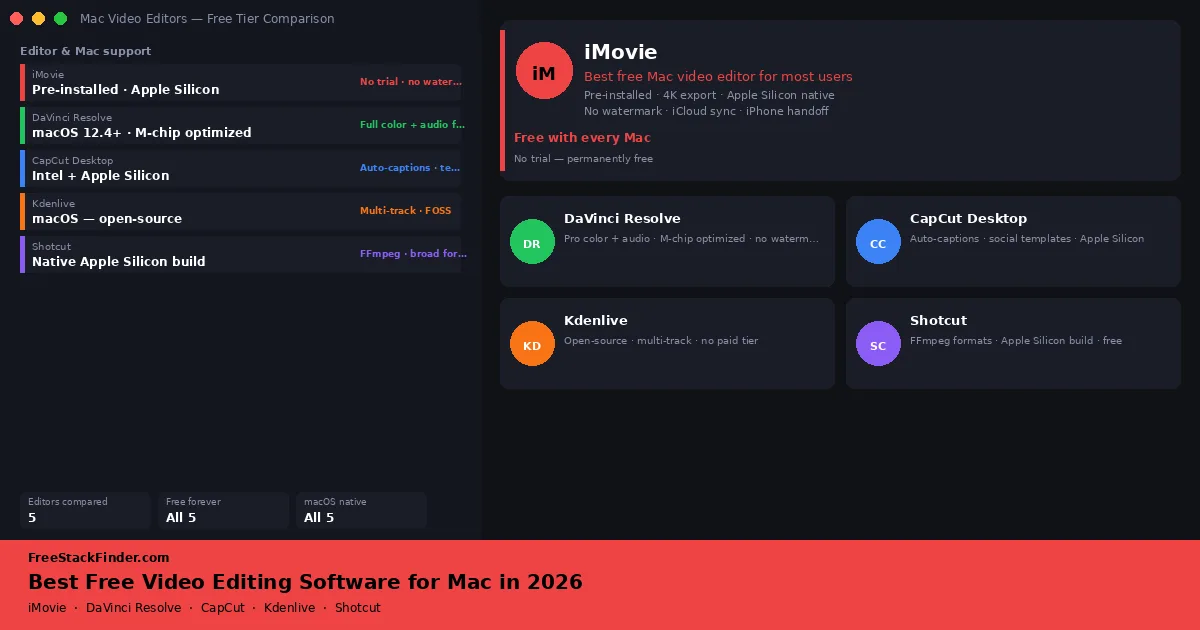
Mac users switching from Premiere will also find platform-specific guidance, including iMovie as a starting point, Apple Silicon performance notes, and macOS codec considerations, in our free video editing software for Mac guide.
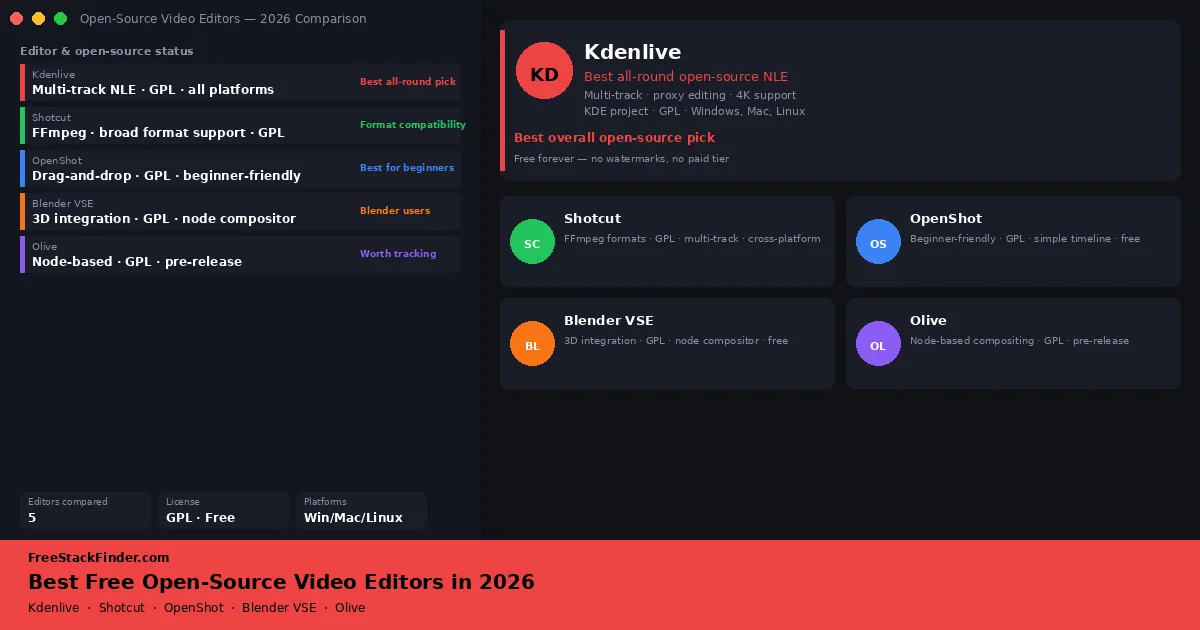
If open-source licensing and source availability are priorities, our guide to free open-source video editors covers Kdenlive, Shotcut, OpenShot, and Blender VSE in depth.