Start with the business model
Free VPNs need careful screening because servers, bandwidth, and app maintenance cost money. Some plans use ads, collect more data than readers expect, or function as short trials. Proton VPN Free is the default recommendation here because it combines unlimited data with open-source apps and published third-party audits. Windscribe Free provides a selectable set of countries but imposes a monthly data cap. TunnelBear Free is useful for limited browsing, although free accounts no longer include country selection.
Think of a free VPN as a narrow privacy tool, not a full replacement for a paid VPN. The details that matter most are data caps, server choice, speed priority, privacy posture, streaming support, and device coverage. Unlimited data with limited server choice is usually better for basic public Wi-Fi protection, while a larger country list with a monthly cap is better when you need a specific region for light browsing. Streaming, torrenting, and daily always-on protection are where free tiers usually stop making sense.
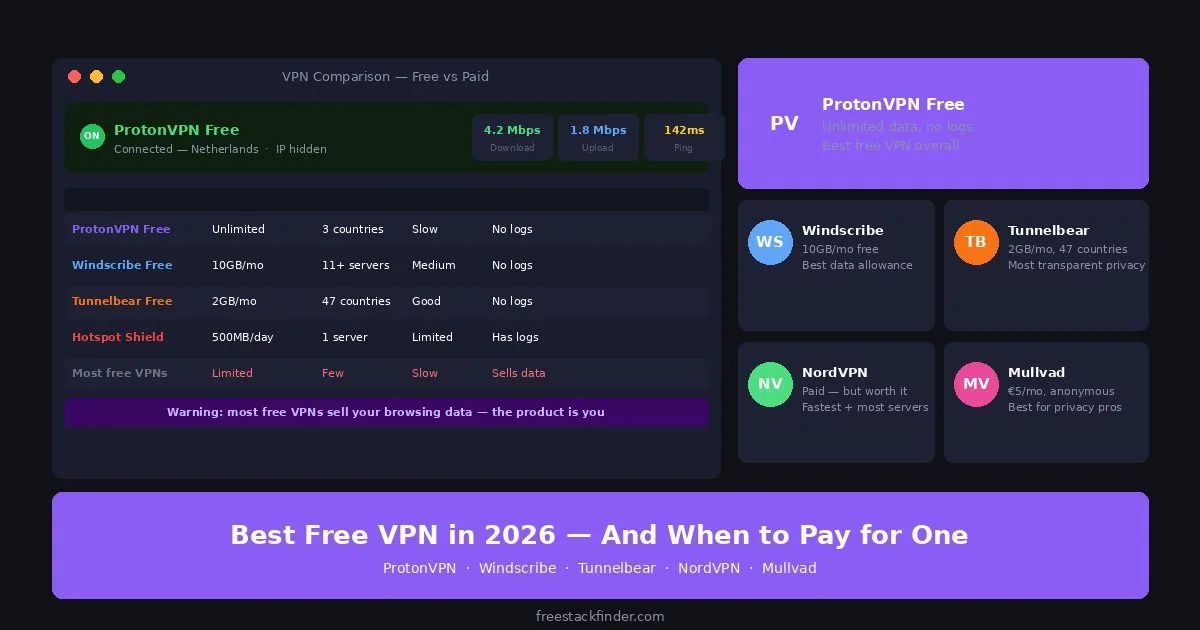
| Tool | Best for | Free plan | Main limitation |
|---|---|---|---|
| Proton VPN Free | Regular browsing without a data cap | Unlimited data and published audits | Automatic assignment across 10 countries |
| Windscribe Free | Users who need more server variety | 2 GB/month, or 10 GB with a confirmed email | Monthly data cap can run out quickly |
| Tunnelbear Free | Short sessions with published audit history | 2 GB/month and no device cap | Country selection requires paid |
A free VPN still needs a funding model
A VPN requires servers, bandwidth, and ongoing maintenance. A provider can fund a free tier through paid subscriptions, advertising, or other commercial relationships. Its privacy policy and published security work therefore matter as much as the monthly allowance.
A CSIRO-led study of 283 Android VPN apps found third-party tracking libraries, sensitive permissions, insecure tunnelling, and traffic manipulation among the apps it examined. The study is old enough that it should not be used to judge today’s version of a named app, but it explains why an app-store rating is weak evidence for a VPN.
The three services below publish clear free-plan limits and fund those plans through paid products. That does not make any VPN risk-free. Check the provider’s current privacy policy, audit scope, ownership, and support record before routing sensitive traffic through it.
For securing other aspects of your digital life alongside a VPN, see our free password managers guide and free antivirus software guide for the complete free security toolkit.
Also remember what a VPN does not do. It does not make weak passwords safe, remove malware from a device, or stop a website from collecting data you willingly submit. A trustworthy free VPN can protect traffic on public Wi-Fi and mask your IP address, but it should sit alongside good passwords, software updates, and careful account security rather than replacing them entirely. Treat it as one layer, not the whole security stack or a shortcut around basic daily security hygiene for accounts.
Three free VPN plans worth comparing
1. Proton VPN Free: unlimited data with automatic server choice
Best overallProton VPN comes from the same Swiss company as Proton Mail and Proton Drive. Its free plan has no data allowance, and Proton publishes its apps’ source code and third-party audit reports.
The free plan has no data limit. Its free servers are currently distributed across ten countries, but the app initially chooses the fastest available server. A manual change sends you to another randomly selected country and can trigger a cooldown, as described in Proton’s free-server documentation.
Compared with paid plans, the limits are server choice, simultaneous connections, and specialist servers. Proton does not guarantee streaming access on its free servers, and features such as Secure Core and P2P servers require a paid plan.
Proton VPN Free fits regular browsing on one device when a specific exit country is not required. Its lack of a data cap matters more than a long country list for that use.
2. Windscribe Free: best free VPN for server variety
Best for varietyWindscribe is a Canadian VPN with a free tier that trades a monthly data allowance for selectable server locations.
Compared with Proton VPN Free, Windscribe makes more sense if selecting a country matters more than unlimited data. Its current free plan includes 2 GB per month without an email address or 10 GB after confirming one, servers in ten countries, browser extensions, the R.O.B.E.R.T. blocker, and connections across multiple devices.
The monthly allowance is the main constraint. Video and large downloads can use it quickly, while paid plans add more locations and unlimited data. Windscribe publishes privacy and audit material, but readers should still check the scope and date of each report rather than treating the word “audited” as a permanent guarantee.
Windscribe fits users who need to choose among its free countries and can work within a monthly data cap. Its browser extension also suits people who want to route browser traffic without enabling the device-wide connection.
3. TunnelBear Free: 2 GB for short sessions
Most transparentTunnelBear is a Canadian VPN with a 2 GB monthly free tier and a history of publishing independent security audits.
The current free plan includes 2 GB of browsing per month and does not cap the number of installed devices. TunnelBear moved country selection to paid plans in late 2025, so a free account is no longer a way to choose among its full location list. The company also publishes its annual audit updates, including the issues found and their status.
The 2 GB cap is the practical barrier. It is suitable for short browsing sessions, not an always-on connection or regular video. TunnelBear offers apps for Windows, macOS, iOS, and Android, but not a native Linux app.
TunnelBear fits occasional use when a small allowance and automatic location are acceptable. Choose Proton VPN instead when the connection needs to remain on for longer periods.
Skip providers that cannot explain their business model
Do not install a VPN solely because it ranks highly in an app store. Avoid providers that do not identify the operating company, publish a readable privacy policy, explain what the free tier records, or disclose how the service is funded. A public audit is useful only when its date, scope, and findings are available.
When to pay for a VPN
A paid VPN makes sense for guaranteed streaming support, P2P servers, specific countries, or several simultaneous connections. Proton VPN Free’s server-selection and connection limits are the most likely reasons to upgrade.
Before upgrading, identify which free-tier limit you hit. If the problem is data, ProtonVPN Free may solve it better than another data-capped free service. If the problem is server location or speed, a paid plan is more likely to help. If the problem is privacy trust, avoid chasing the most generous free allowance and choose the provider with the clearest audit history and business model.
Ready to upgrade from a free VPN?
NordVPN has an independently audited no-logs policy, covers up to 10 devices on one account, and includes Threat Protection for malicious sites and trackers.
Get NordVPN →Proton VPN’s paid tiers add selectable countries, more simultaneous connections, and supported streaming servers. That is the simplest upgrade path if you already use the free app and its server limits are the problem.
For the full free security stack alongside your VPN, see our free 2FA authenticator apps guide: a VPN protects your connection while 2FA protects your accounts. If you manage a website or server, our free security audit tools guide covers how to find exposed ports and web vulnerabilities before attackers do.
Use Proton VPN unless you need country selection
Choose Proton VPN Free for unlimited browsing when automatic server assignment is acceptable. Choose Windscribe Free when you need a country from its free list and can stay within 2 GB or 10 GB per month. TunnelBear Free is limited to 2 GB and no longer includes country selection, so it fits short sessions rather than routine use. Move to a paid plan when streaming support, P2P servers, predictable locations, or several simultaneous connections are requirements.