Sync or local control changes the answer
Bitwarden provides unlimited-device sync on a free cloud account. KeePassXC keeps the vault in a local encrypted file and leaves synchronization to you. Paid plans start to make sense for family sharing, business controls, integrated TOTP codes, emergency access, or file attachments. Bitwarden’s free plan already supports FIDO2 WebAuthn security keys for protecting the vault.
The practical decision is device sync first, sharing second, and advanced recovery features third. A password manager you can use on both phone and laptop will protect more accounts than a prettier tool that logs you out constantly. Family and team use changes the equation because shared vaults, emergency access, role controls, and onboarding/offboarding become more important than a solo user’s interface preference. Passkey support is also evolving quickly, so treat it as a feature to verify before committing if passkeys are central to your login workflow.
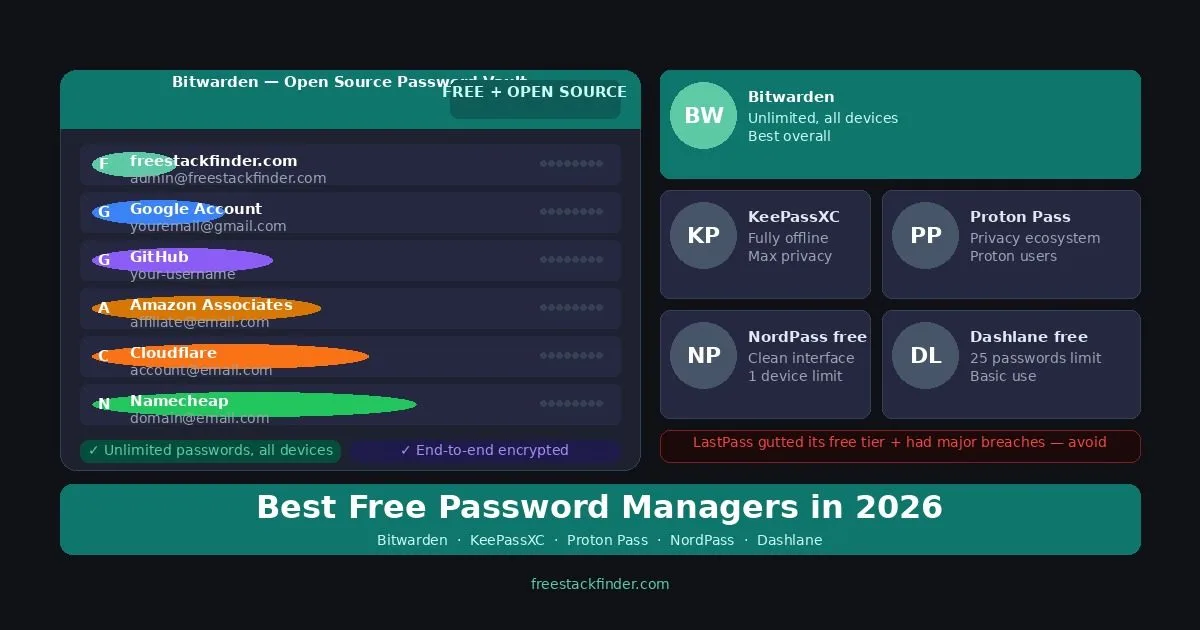
| Tool | Best for | Free plan | Main limitation |
|---|---|---|---|
| Bitwarden | Most users: best overall | Unlimited passwords, unlimited devices, open-source | Integrated TOTP, emergency access, and file attachments require Premium |
| KeePassXC | Zero cloud, maximum privacy | Unlimited local vault, fully open-source, no registration | No official mobile app; sync requires manual file management |
| Proton Pass | Proton app users | Unlimited logins and devices, 10 email aliases | Integrated TOTP and sharing require a paid plan |
| NordPass | Single device, clean interface | Unlimited passwords, guided apps | Only one active device at a time on free |
Sync and recovery are plan features
LastPass restricted free accounts to one device type in 2021. Its 2022 security incident also resulted in an attacker obtaining backups that included encrypted vault data and some unencrypted account and website metadata. Those events are useful reminders to compare both plan limits and a provider’s published security record.
A password manager can generate and store a unique password for each site, reducing the damage caused when one site’s credentials leak. It does not remove every account risk, so the vault still needs a strong master password, multi-factor authentication, and a recovery plan.
Several free plans cover routine individual use. Bitwarden publishes its source code and links its third-party security assessments. Paying is still reasonable when sharing, emergency access, file attachments, or support solves a real need.
A password manager only helps accounts that have been moved into it. Start with email, banking, cloud storage, social accounts, and shopping accounts, then replace reused passwords gradually. Use the manager for new accounts as well; installing it without moving credentials changes very little.
Four free vaults with different recovery models
1. Bitwarden: best free password manager for most users
Bitwarden is an open-source, end-to-end encrypted password manager with unlimited storage across unlimited devices on the free tier, and an independently audited security model.
Bitwarden’s free tier is unusually broad: unlimited passwords, unlimited devices, end-to-end encryption, browser extensions for Chrome, Firefox, Safari, Edge, and more, desktop apps, mobile apps, secure notes, credit card and identity storage, a customizable password generator, and basic two-factor authentication support are all included.
The free account can use an authenticator app, email, or a FIDO2 WebAuthn credential, including a compatible hardware key, for two-step login. Bitwarden lists FIDO2 WebAuthn as free for all users. Premium adds YubiKey OTP and Duo methods, the integrated Bitwarden TOTP generator, encrypted file attachments, emergency access, security reports, and file sharing through Bitwarden Send.
Bitwarden’s unlimited-device policy avoids NordPass Free’s one-active-session limit. It is the broadest default here for readers who want hosted sync without a subscription.
2. KeePassXC: best for users who want zero cloud dependency
KeePassXC is a free, open-source password manager that stores an encrypted vault file on your computer and requires no cloud account.
KeePassXC is completely free and open-source, with an AES-256 encrypted vault stored as a local .kdbx file. It requires no cloud account, registration, or internet connection, and still supports browser integration through KeePassXC-Browser, a fully configurable password generator, SSH key management, TOTP code generation, and desktop apps for Windows, macOS, and Linux.
The sync model is the trade-off. There is no official mobile app, so mobile access depends on third-party apps such as KeePassDX on Android or Strongbox on iOS. Syncing means moving the vault file through cloud storage, USB, or your own server. That requires more setup than a hosted password manager.
KeePassXC fits people who want direct control over where the vault file is stored. The file does not reach a cloud service unless you place it in one, but backup, synchronization, and conflict handling become your responsibility.
3. Proton Pass free tier: best for users already using Proton apps
Proton Pass is Proton’s password manager, built on the same privacy-first principles as ProtonMail and Proton Drive, with a generous free tier.
Proton Pass Free includes unlimited logins and notes, unlimited devices, two vaults, passkey support, and ten hide-my-email aliases. Its current plan comparison puts the integrated TOTP authenticator, secure sharing, unlimited aliases, file attachments, and emergency access on paid plans.
The two-vault limit is enough to separate personal and work items, but it leaves little room for further organization. People who already use Proton Mail or Proton VPN can manage Pass under the same Proton account.
The ten included aliases can keep a primary email address out of routine sign-up forms. If every account needs a distinct alias, the paid plan or a separate alias service is necessary.
4. NordPass Free: one active session
NordPass is Nord Security’s password manager, from the company behind NordVPN.
NordPass gives free users unlimited password storage, end-to-end encryption, a password health checker, browser extensions, and mobile apps.
The account synchronizes data across installed devices, but only one device can have an active session on the free plan. NordPass confirms that limit in its Free and Premium comparison. Password sharing and emergency access require paid plans.
NordPass fits users who mainly access passwords from one device and want guided setup. The one-active-device constraint becomes a daily problem when both a phone and laptop need access.
Dashlane no longer has a free plan
Dashlane discontinued its Free plan on September 16, 2025. Existing free users could export their data after that date, but could no longer view, edit, or add vault items; Dashlane set September 16, 2026 as the export deadline. Read Dashlane’s transition notice if you still have data in an old free account. Dashlane is therefore not ranked as a current free password manager.
A note on LastPass
LastPass is not ranked in this guide. Its Free plan has been limited to one device type since 2021. In the 2022 incident, an attacker copied backups containing encrypted vault fields and unencrypted data such as website URLs, as described in LastPass’s incident notice. Compare that record and the current Free restrictions with the sync, local-storage, and recovery models above before choosing a vault.
When a paid password manager makes sense
Paid password manager plans make sense for families that need shared collections alongside private vaults. Bitwarden currently lists Families at $47.88 per year for up to six users. Compare the renewal price and account-recovery model before moving a household.
Businesses also benefit from paid team password managers: shared vault access with role-based permissions, user onboarding and offboarding controls, and audit logs are all features that matter at team scale and are not available on free tiers. For the full breakdown of free and low-cost team options, see our free password managers for teams guide.
FIDO2 WebAuthn security keys work with Bitwarden Free. Premium is required for YubiKey OTP and Duo, which are separate two-step login methods, as well as the integrated TOTP generator. Bitwarden currently lists Premium at $19.80 per year.
For most individual users, paying should not be the first security move. The bigger win is moving every account into one password manager, replacing reused passwords with unique generated ones, and enabling two-factor authentication on email, banking, and the password manager itself. Once that habit is in place, paid features are easier to judge: emergency access matters if someone else may need to recover your vault, sharing matters if a household or business needs common credentials, and hardware-key support matters if your accounts justify stronger login protection.
NordPass and NordVPN use the same account family
NordPass is the password manager from the same company as NordVPN. It offers a competitive free tier with unlimited passwords on one active device. If you are already using or planning to use NordVPN, NordPass integrates within the same account: one subscription can cover VPN, password manager, and encrypted storage (NordLocker) together.
Already using NordVPN? Add NordPass for free.
NordPass is Nord Security's password manager. The free tier stores unlimited passwords but works on one active device. Premium adds multi-device sync and password sharing.
Try NordPass free →For protecting those accounts with a second factor beyond your password, see our free 2FA authenticator apps guide: enabling 2FA on your email and password manager itself is the most important next step after choosing a password manager.
Move email and banking accounts first
Bitwarden Free is the default for individual users who need sync across devices. KeePassXC is the local-file choice, and Proton Pass fits people already using Proton services. Pay when sharing, business administration, integrated TOTP, emergency access, or attachments are missing. Whichever tool you pick, protect the password-manager account itself with 2FA; our free authenticator apps guide covers that next step.