Local files and team databases solve different problems
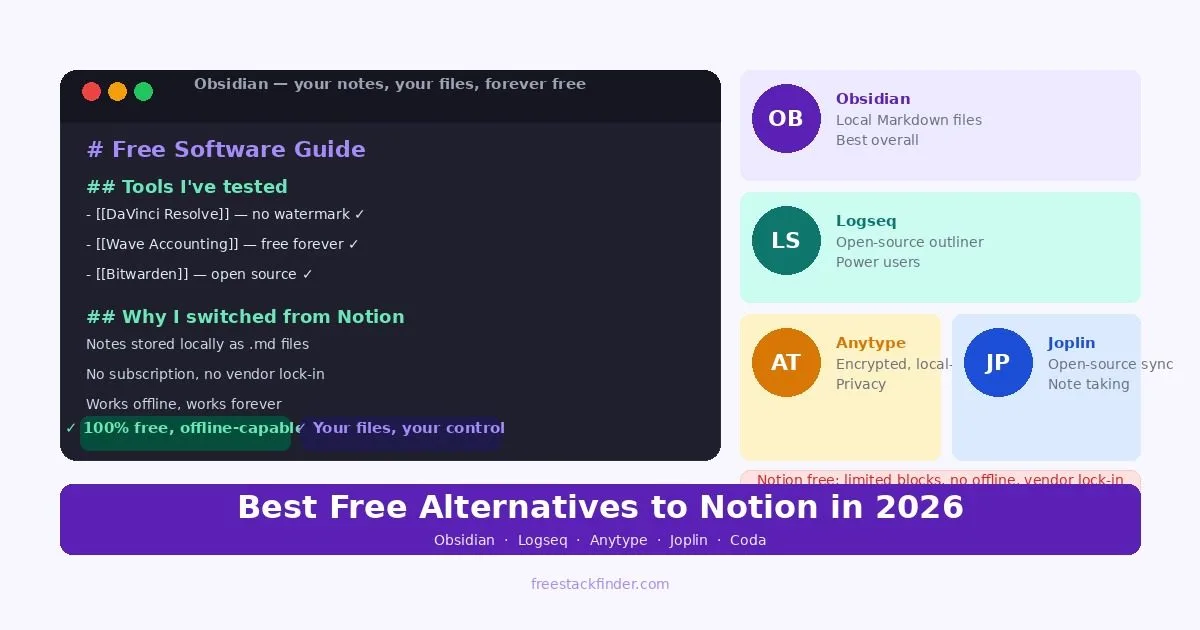
Choose Obsidian when local Markdown files, offline access, and a large plugin library matter more than real-time collaboration. Choose Logseq if you prefer an outliner, or Anytype if you want a block editor that stays closer to Notion. Paying for Notion makes more sense when a team depends on shared databases, permissions, and a company wiki. Solo note-taking rarely needs that overhead.
Local notes and team databases solve different jobs
Notion’s Free plan works differently for individuals and teams. A one-person workspace has unlimited blocks, while a free workspace with two or more members is limited to 1,000 blocks. Notion now lets members on every plan download individual pages for offline use in its desktop and mobile apps; paid plans also download recent and favorite pages automatically.
The other common trigger is privacy. Notes are often the most sensitive data a person creates: personal journals, work strategies, client information, research on health or financial topics. Storing all of that in a third-party cloud platform requires a level of trust that many users are no longer comfortable extending by default.
For users who want to switch, the main concerns are usually feature parity and migration effort. Several alternatives accept Markdown exported from Notion, but databases, permissions, templates, and linked views still need manual rebuilding.
Five ways to replace Notion
1. Obsidian: best free Notion alternative for personal knowledge management
Obsidian is a free local-first note-taking application that stores all notes as plain Markdown files in a folder on your own computer.
What you get for free:
- Local notes and core editing require no subscription or account
- Notes stored as plain .md files in a folder you own
- Backlinks and graph view to see connections between notes
- Large plugin library: hundreds of community plugins for calendars, tasks, databases, and more
- Full offline access: works without internet
- Available on Windows, macOS, Linux, iOS, and Android
Where the free tier ends:
- Obsidian Sync is a paid add-on; third-party file-sync setups require platform-specific configuration
- Publish feature (sharing notes publicly) requires a paid add-on
- The local-file and plugin workflow requires more setup than Notion’s hosted workspace
Strong fit for: Writers, researchers, developers, and students who want local Markdown files, offline access, and no subscription.
Obsidian stores notes as Markdown files in a folder on your computer. They open in ordinary text editors and remain accessible without an Obsidian account. Backlinks and graph view add a way to inspect connections between those files, while Notion keeps its workspace data inside a hosted service. Obsidian publishes current add-on prices and storage limits on its pricing page.
For productivity tools that pair well with Obsidian, also see our free Microsoft Office alternatives guide for document editing options.
2. Logseq: best open-source outliner for networked note-taking
Logseq is a free, open-source knowledge management tool built around an outliner structure, storing notes as local Markdown or Org-mode files.
What you get for free:
- Open-source local application with no paid feature tier
- Local-first storage: notes are files on your device
- Outliner-based editing with indented bullet structure
- Bidirectional links and graph view
- Task management with queries and filters
- Journal-style daily pages
- Available on Windows, macOS, Linux, and mobile (iOS/Android)
Where the free tier ends:
- The outliner structure takes time to adjust to: it is more opinionated than Notion’s flexible blocks
- Database-style views are less developed than Notion’s tables and boards
- Sync across devices requires third-party cloud storage (similar to Obsidian)
- The block and query workflow requires more setup than Notion
Strong fit for: Power users who want an outliner-first workflow, researchers who think in connected ideas rather than linear documents, and anyone who prefers open-source tools.
Logseq follows the same local-file approach as Obsidian but uses a different structure. Each bullet is a block that can be referenced, tagged, and queried independently. Choose that model for daily notes and connected outlines; choose Notion when database views and team collaboration matter more.
3. Anytype: best privacy-first Notion alternative with a generous free tier
Anytype is a local-first, end-to-end encrypted knowledge management app that offers a Notion-like block-based interface while keeping data on your device by default.
What you get for free:
- Local-first storage with end-to-end encryption
- Block-based editing similar to Notion: pages, databases, kanban boards, and more
- On-device storage and peer-to-peer sync using Anytype’s local-first model
- Object-based data model for connecting different types of content
- Available on Windows, macOS, Linux, iOS, and Android
Where the free tier ends:
- Still in active development, with fewer mature collaboration controls than Notion
- Smaller community and plugin library than Obsidian
- The object-based model has a learning curve for users coming from Notion
- Hosted network storage and collaboration limits depend on the current membership
Strong fit for: Users who want a Notion-like block-based interface but with privacy-first architecture, and anyone moving away from Notion who wants the least amount of workflow disruption.
Anytype uses a block editor, database views, and page hierarchy while storing data on the device. Its published membership model keeps local storage and peer-to-peer sync available without payment, while hosted network resources have plan limits. Check Anytype’s membership explanation before planning shared or hosted work.
4. Coda free tier: best Notion replacement for document-centric teams
Coda is a cloud document platform that combines documents, spreadsheets, and databases. Its free tier gives document-focused teams more room than Notion in several areas.
What you get for free:
- Personal docs have no page or object limit
- Tables, views, and basic automation
- Doc sharing and collaboration
- Coda AI features (limited on free)
- Available in browser and as a mobile app
Where the free tier ends:
- Shared free docs are limited to 50 objects and 1,000 table rows
- Version history is limited to 7 days on free
- External sharing controls are more limited than paid tiers
- No offline mode: requires internet connection
Strong fit for: Small teams who want a Notion-like tool for collaborative documents without hitting block limits, and users who primarily use Notion for documents and wikis rather than personal notes.
Coda treats reports, wiki pages, and project briefs as documents first. Its tables sit inside those documents and behave more like spreadsheets than Notion databases. Personal documents have different limits from shared ones, so check Coda’s free doc limits before moving a team workspace.
5. Joplin: best free open-source note-taking for Evernote and Notion refugees
Joplin is a free, open-source note-taking application that syncs across devices using your own cloud storage, supporting Markdown and rich formatting.
What you get for free:
- Open-source desktop and mobile applications
- Notes stored in an open format
- Sync via Dropbox, OneDrive, Nextcloud, or your own WebDAV server: all free
- End-to-end encryption option
- Web clipper browser extension
- Available on Windows, macOS, Linux, iOS, and Android
Where the free tier ends:
- Interface exposes more database structure than Notion or Anytype
- No database views, kanban boards, or structured data features
- Sync setup requires more technical steps than Notion
- Limited collaboration features
Strong fit for: Users who primarily need a note-taking tool rather than a full workspace, Evernote refugees looking for a privacy-respecting replacement, and users who want sync without paying for yet another subscription.
Joplin occupies a different category from the other tools in this list. It is a note-taking app, not a workspace. It can handle ideas, clipped articles, journals, and reference material, with sync through supported storage providers. It is less suitable for a company wiki or a project that depends on database views and team permissions.
Compare storage, structure, and collaboration
| Tool | Storage | Offline | Collaboration | Best for |
|---|---|---|---|---|
| Obsidian | Local files | ✅ Full | ⚠️ Limited | Personal knowledge base, writers |
| Logseq | Local files | ✅ Full | ⚠️ Limited | Networked thinking, power users |
| Anytype | Local + encrypted sync | ✅ Full | ✅ Yes | Notion-like interface, privacy |
| Coda | Cloud | ❌ No | ✅ Strong | Team docs, wikis |
| Joplin | Local + your cloud | ✅ Full | ⚠️ Limited | Simple note-taking, Evernote replacement |
| Notion free | Cloud | ⚠️ Manual page downloads | ✅ Yes | Solo workspaces and guest sharing |
When Notion’s paid plan still fits
Notion’s paid plans make the most sense when one workspace carries project tracking, a team wiki, internal documentation, and product roadmaps. At that point, shared permissions and database relationships can justify the cost, especially if moving everyone to a more technical tool would create a training burden.
Large teams also face a real switching cost. Linked databases, template buttons, and automations do not migrate as neatly as plain pages. Moving dozens of people is a project, not a quick account export.
Paid AI features can also reduce tab switching for documentation-heavy teams by summarising notes, filling database properties, and drafting inside the workspace. That convenience matters less if those tasks are occasional or your team already uses a separate writing tool.
Local files for individuals, shared databases for teams
Obsidian is the clearest pick for a personal knowledge base because the notes remain ordinary files you control. Anytype asks for less workflow change if you prefer Notion’s block-based approach. Keep paying for Notion when the team relies on shared databases, permissions, and defined processes. Storage alone does not justify the upgrade.
For a lighter note-capture tool, see our free note-taking apps guide for Google Keep, Standard Notes, and Simplenote. Our free writing tools guide covers drafting and editing, while the free calendar apps guide compares Notion Calendar with standalone schedulers.