Adobe Acrobat Pro is a paid subscription. That can make sense for daily PDF production, but occasional text edits, annotations, forms, signatures, merging, and compression are available in free tools. Check Adobe’s current pricing if cost is the deciding factor.
“Free PDF editor” covers browser tools with usage limits, full desktop applications, and annotation-only apps. Start with the edit you need and whether the file can leave the device.
The edit determines the tool
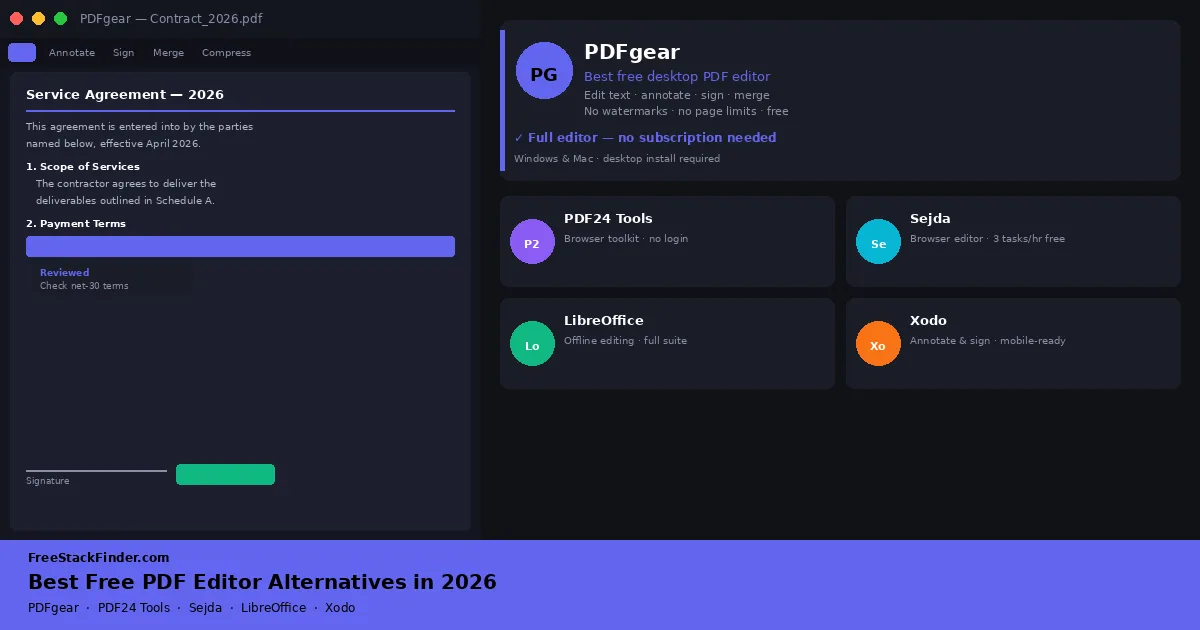
PDFgear is a desktop application for text and layout edits without a watermark or page cap. PDF24 Tools handles browser-based conversions and one-off changes. Sejda is a web editor with usage limits, LibreOffice Draw keeps basic layout work offline, and Xodo focuses on annotation and signing on mobile.
| Tool | Best for | Free plan | Main limitation |
|---|---|---|---|
| PDFgear | Most users needing a full editor | Full desktop app, no watermarks | Desktop install required |
| PDF24 Tools | Quick browser-based tasks | Unlimited tools, no account required | Browser-only, slower for large files |
| Sejda | Moderate weekly PDF work | 3 tasks per hour, 200 pages per file | Task limits on free plan |
| LibreOffice Draw | Offline editing, existing LibreOffice users | Full desktop suite, no limits | Complex editing flow for non-technical users |
| Xodo | Annotation and signing on mobile | Full annotation and form filling free | Limited text editing beyond annotations |
Five free PDF editors and toolkits
1. PDFgear: best free desktop PDF editor
Best overallPDFgear is a full PDF editor for Windows and Mac that covers text editing, annotations, form filling, signing, merging, splitting, compressing, and converting: all without a watermark or account requirement.
What the free tier handles:
- Edit existing PDF text directly (add, modify, delete)
- Add and edit annotations: highlights, comments, shapes, stamps
- Fill out PDF forms
- Add e-signatures (draw, type, or image upload)
- Merge multiple PDFs into one
- Split a PDF into separate files
- Compress PDF file size
- Convert PDF to Word, Excel, image formats
- OCR for scanned documents
- No page limits, no watermarks, no login required for basic use
Where the free tier stops:
- Some advanced AI-powered features are gated behind an account
- The mobile app has fewer features than the desktop version
- No cloud sync or web access: desktop install only
The natural audience: People who regularly handle contracts, invoices, or forms and want a desktop editor without an Acrobat subscription.
Most tools in this space either add watermarks, cap pages, or gate editing behind a paywall. PDFgear gives a complete editing experience on the free tier. The interface is clean and closer to Acrobat than most open-source alternatives.
2. PDF24 Tools: best browser-based PDF toolkit
Best for quick tasksPDF24 Tools is a browser-based suite of over 25 PDF utilities, edit, compress, merge, split, convert, OCR, sign, and more, accessible without an account.
What the free tier handles:
- Over 25 distinct PDF tools accessible from the browser
- Merge, split, compress, rotate, convert, and password-protect PDFs
- PDF to Word, Excel, image, and back
- OCR for scanned files
- Basic annotation tools
- No account required to use any tool
- Files are deleted from servers after processing
Where the free tier stops:
- Not designed for sustained text editing: tools are task-by-task, not a persistent editor session
- Slower with large files and batches than a local desktop app
- The PDF24 desktop app is also free but more limited than PDFgear in editing depth
The natural audience: Anyone who needs to run a quick PDF task, compress before emailing, merge two files, convert a scan to text, without installing software or creating an account.
The number of tools in a single free, no-login interface is hard to match. For occasional PDF work and file format conversions, PDF24 Tools avoids extra setup.
3. Sejda: best web editor for moderate use
Good for occasional workSejda is a browser-based PDF editor and toolkit with a clean interface and a generous free tier for users who work with PDFs regularly but not daily.
What the free tier handles:
- Text editing directly in PDFs
- Add text, images, shapes, and highlights
- Fill and sign PDF forms
- Merge, split, compress, and convert PDFs
- Whiteout tool to remove or cover content
- 3 tasks per hour, files up to 200 pages and 50 MB
Where the free tier stops:
- Task limits (3 per hour) can be reached quickly during active PDF sessions
- Premium tier required for unlimited use
- Processing happens on Sejda’s servers; do not upload confidential documents
The natural audience: Users who handle PDFs a few times a week and want a clean browser editor without installing software. The hourly task limit is rarely hit by casual users.
Sejda supports browser-based text editing and form filling, two tasks that many free PDF tools limit to annotations.
4. LibreOffice Draw: best for offline power users
Best offline optionLibreOffice Draw is the drawing and layout application in the LibreOffice suite, which can open, edit, and export PDFs as part of its vector graphics workflow. LibreOffice is a complete free Microsoft Office alternative: Draw handles PDFs as editable files rather than treating them as locked documents.
What the free tier handles:
- Open any PDF as an editable file
- Modify text, images, shapes, and layout elements
- Export back to PDF
- Full vector drawing and layout tools
- Completely offline: no server processing
- No page limits, no watermarks, no account
- Available on Windows, Mac, Linux
Where the free tier stops:
- Editing complex PDFs can produce cluttered layers: best for documents created in office tools rather than design-heavy PDFs
- Steeper learning curve than a dedicated PDF editor: the interface is designed for drawing, not PDF review
- No form-filling or e-signature workflow built in the way dedicated PDF tools provide it
The natural audience: Users who already have LibreOffice installed, work offline, and occasionally need to modify PDF text or layout without a specialized tool. Also useful in environments where cloud-based PDF processing is not allowed.
For users who already have LibreOffice (see our free spreadsheet alternatives guide for context), Draw adds PDF editing without requiring a separate install. It’s the most privacy-preserving option since nothing leaves your machine.
5. Xodo: best for annotation and signing on mobile
Xodo is a PDF annotation, form-filling, and signing tool available on Android, iOS, Windows, and in the browser. Focused on reviewing and signing workflows rather than content editing.
What the free tier handles:
- Highlight, underline, strikethrough, and comment on PDFs
- Fill out interactive PDF forms
- Create and apply e-signatures
- Annotate PDFs shared with collaborators
- Works across mobile and desktop
Where the free tier stops:
- Limited text editing beyond adding annotations, not designed for editing existing PDF body text
- Cloud sync requires account creation
- Some advanced features require paid upgrade
The natural audience: Users who primarily read, annotate, and sign PDFs rather than edit their content: common workflows for students reviewing documents, professionals signing contracts, and teams reviewing drafts.
Xodo’s mobile annotation experience is among the better free options, and it handles form filling reliably across different PDF types. A reasonable choice for anyone who signs and marks up documents more than they write them.
Compare local and browser-based PDF editing
| Task | Best free tool |
|---|---|
| Edit PDF text | PDFgear (desktop) or Sejda (browser) |
| Annotate and comment | Xodo or PDFgear |
| Fill and sign forms | PDFgear, Xodo, or Sejda |
| Merge or split PDFs | PDF24 Tools or PDFgear |
| Compress a large PDF | PDF24 Tools or PDFgear |
| Convert PDF to Word | PDFgear or PDF24 Tools |
| Edit offline, no account | LibreOffice Draw or PDFgear |
| Quick browser task, no install | PDF24 Tools or Sejda |
When the free edit stops working
Most users do not need to pay for PDF software. The free tools above cover the tasks that come up most often: editing, annotating, signing, merging, and compressing files.
Consider a paid tool when:
- You process high volumes of PDFs daily in a professional workflow (legal, finance, document-heavy operations)
- You need advanced redaction, certified signatures, or compliance-grade audit trails
- Your organization requires integration with document management systems or enterprise DMS platforms
- You work with heavily designed or print-ready PDFs where precise layout control matters
For most freelancers, students, small businesses, and home users, PDFgear or PDF24 Tools cover the full range of common tasks at no cost.
If your PDF needs overlap with general document creation, also see our guides on free Microsoft Office alternatives and free note-taking apps: both cover document workflows that often sit alongside PDF work.
PDFgear for editing, PDF24 for quick browser tasks
Choose PDFgear for regular desktop editing, PDF24 Tools for a quick browser conversion, and Sejda when its free usage limits fit an occasional edit. LibreOffice Draw keeps the work local for people who already use LibreOffice. Xodo is aimed at annotation and signing, especially on mobile.
The dividing line is content editing versus markup. If you only annotate, fill, or sign, a lighter browser or mobile tool is enough. Repeated text and layout changes are where a desktop editor, or eventually a paid Acrobat plan, starts making sense.