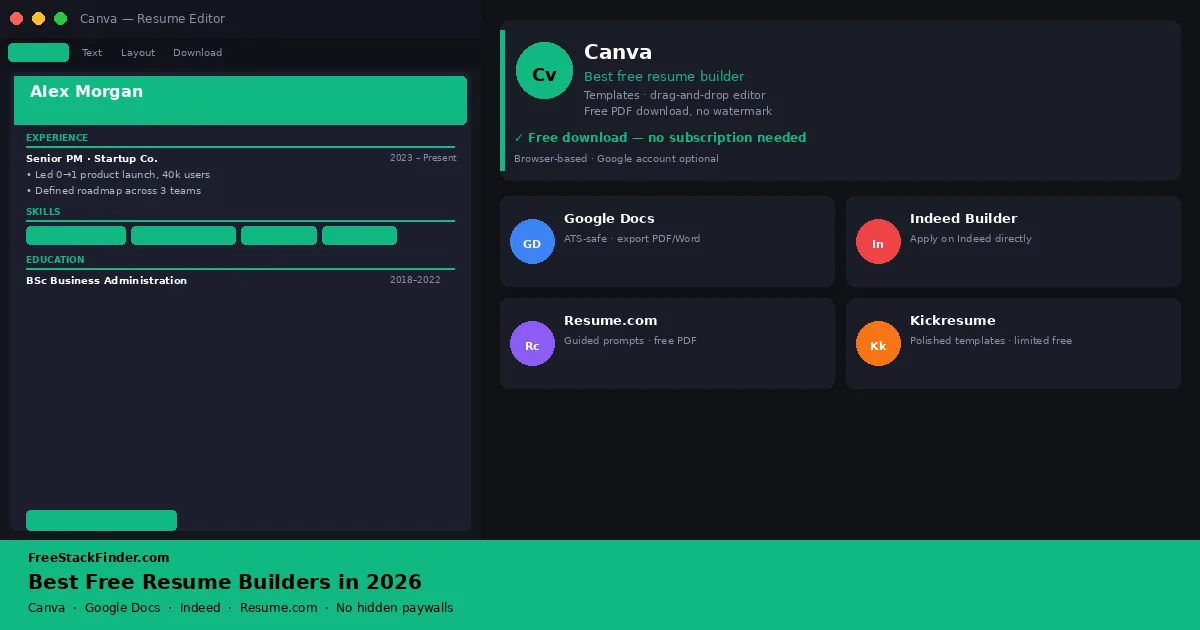
Some resume builders let a free account create a document but charge for the final download. The tools ranked here provide a usable PDF or document export without requiring a subscription.
This guide focuses on free plans that can produce a usable resume without requiring a subscription at the export step.
A free resume builder covers a first CV, a profile update between contracts, a career-change resume, or a one-page application for a specific role. The tools below export a clean PDF without a recurring subscription.
PDF access comes before template choice
Start with the application path, not the template. Use Google Docs for a single-column resume likely to pass through an applicant tracking system. Use Canva for a watermark-free PDF sent directly to a person. Indeed Resume Builder removes an upload step on Indeed, while Resume.com provides section prompts for a first draft.
The practical rule: use Canva when presentation matters, Google Docs when readability matters, Indeed when platform speed matters, and Resume.com when you need help turning work history into bullets.
| Tool | Best for | Free plan | Main limitation |
|---|---|---|---|
| Canva | Visual, design-forward resumes | Templates + free PDF/PNG download | Designed layouts may reduce ATS parsing accuracy |
| Google Docs | ATS-friendly resumes, full control | Full editor, export to PDF or Word | Template variety is limited; design is basic |
| Indeed Resume Builder | Active Indeed job seekers | Build and apply directly on Indeed | Primarily useful within the Indeed platform |
| Resume.com | Guided, step-by-step resume building | Basic templates + free download | Fewer design options than Canva |
Free download claims can hide export limits
The problem with most resume builders is the gap between “free to create” and “free to use.” Many services allow you to fill in your details and preview a complete resume: then require payment to download it as a PDF. This model is common enough that you should assume a paywall exists until you have confirmed otherwise.
Design and ATS compatibility pull in opposite directions. Columns, icons, graphics, and custom fonts can help a direct application but may break sequential parsing in an applicant tracking system. A plain single-column document is safer when software reads the resume first.
The tools below either let you download for free or offer genuine value without requiring a PDF export.
Four builders that export a usable resume
1. Canva: best free resume builder for most people
Best overallCanva is a design tool first, so its templates offer more layout control than dedicated resume builders. That helps with freelance, creative, and direct applications. Use a simpler single-column document for strict ATS screening.
On the free plan, the useful pieces are:
- Hundreds of resume templates (a subset of premium templates requires Canva Pro)
- Drag-and-drop editor for text, layout, and colors
- Export to PDF, PNG, or share a public link
- No watermark on free downloads
- Works in any browser, no installation required
- One-page and two-page layouts available
Check these limits before committing to a template:
- Some templates are labeled “Pro” and require a paid subscription
- Brand Kit and custom font features require Canva Pro
- No built-in ATS optimization or job description matching
- Designed layouts with columns and icons may not parse cleanly through strict ATS systems
Choose Canva when the resume will be viewed by a person before it is parsed by software: a portfolio role, freelance proposal, agency application, startup introduction, or client-facing profile. It is also useful when you want a resume, one-page bio, and portfolio document to share a consistent look. Canva’s creative tools are covered in depth in our free Canva alternatives guide if you want to compare the broader design platform options.
The reason Canva earns the top spot is the download step. Many resume builders let you build for free and then charge for the PDF. Canva gives you real design variety and lets you export immediately on the free plan, as long as you avoid Pro-only template elements.
2. Google Docs: best for ATS-friendly resumes
Best for ATS compatibilityGoogle Docs is the plainest option here, and that is exactly why it works. It gives you a normal document editor, a few built-in resume templates, and full control over spacing, headings, bullet points, and export format.
Its free setup covers the practical resume workflow:
- Free resume templates built into Google Docs (accessible from File → New → From template)
- Full document editor with headers, bullet points, columns, and custom styles
- Export to PDF or Microsoft Word (.docx) at no cost
- Real-time collaboration: useful for getting feedback from a mentor or career advisor
- Works offline via the Chrome extension
- No account required to view; Google account (free) required to edit and save
The limits are mostly about design and guidance:
- Template variety is limited compared to dedicated resume builders
- No guided content suggestions or bullet point writing prompts
- Design customization requires manual formatting rather than drag-and-drop
Use Google Docs for large employers, corporations, government roles, recruiters, or any application funnel where an ATS is likely to read your file before a person does. A clean, single-column Google Docs resume exported to PDF is one of the safest formats for parsing. It is also the right choice if you already use Google Workspace and want your resume beside your other documents: see our free Microsoft Office alternatives guide for the broader picture of document tools.
The Google Docs file stays portable. You can download it as PDF or Word, edit it without returning to a proprietary resume platform, and keep a version history for role-specific copies.
3. Indeed Resume Builder: best for active Indeed applicants
Indeed Resume Builder is less about design and more about application speed. It creates a structured resume inside the Indeed platform, then lets you attach that resume directly to job applications.
The free workflow includes:
- Guided step-by-step resume building with section prompts
- Resume visible to recruiters searching Indeed’s resume database
- Apply to jobs on Indeed directly with your stored resume
- Download as PDF at no cost
- Available on desktop and mobile
The main constraints are tied to the platform:
- Resume design is functional but basic: limited template variety
- Built mainly for Indeed; less suitable as a general-purpose resume
- Privacy setting controls matter: your resume is searchable by default unless you set it to private
Use it if Indeed is your main job board and you value speed over presentation. It is especially useful for high-volume applications, entry-level searches, local roles, and situations where being searchable by recruiters is part of the strategy. If you do not want that visibility, set the resume to private before adding personal details.
For people applying mainly through Indeed, keeping the resume on the platform removes an upload from every application.
4. Resume.com: best guided free builder
Resume.com is a guided builder for turning a blank page into a structured draft with sections and bullet prompts. It does not offer the layout control of Canva or Google Docs.
The no-cost builder gives you:
- Guided section-by-section resume builder
- Pre-written bullet point suggestions by job title and industry
- Select basic templates and download as PDF
- Cover letter builder included
- Basic customization of colors and fonts
The trade-offs show up in template choice and upgrade pressure:
- Premium templates and advanced design features require a paid subscription
- The free tier has fewer template choices than Canva
- Upgrade prompts may appear during the build process
Use Resume.com when the writing process is the hard part: a first resume, a return after a work gap, a career change, or a job history that needs help turning responsibilities into concise bullet points. The guided approach is more useful than a blank document for people who find resume writing difficult.
The pre-written suggestions are not a finished resume, but they are a useful starting point for the hardest part: writing bullet points. Rewrite them with your own numbers, outcomes, and specifics. For refining bullet point language and tone further, pairing Resume.com with a grammar and writing tool is practical: see our free Grammarly alternatives guide for options that work across any editor.
A note on tools we did not include
Zety allows free resume building but requires payment to download: the free tier ends at the download step. We did not include it as a primary recommendation because the core output requires a subscription.
Novoresume has a free plan with one basic template and limited sections. It may work for a minimal resume, but the free tier is narrow enough that most users will hit its constraints quickly.
Kickresume offers a free plan with a limited template set, while premium templates and generated content are paid. Check it only if Canva’s layouts do not fit the target industry.
Microsoft Word Online is a reasonable option if you already have a Microsoft account: Word templates include several resume layouts, and the free web version exports to .docx cleanly. For people who already use Microsoft apps, it works similarly to Google Docs.
Compare export and editing control
| Situation | Best tool |
|---|---|
| Applying to a large corporate employer | Google Docs (clean ATS format) |
| Creative industry or startup role | Canva (layout control) |
| Active Indeed applicant | Indeed Resume Builder |
| First resume or returning to work | Resume.com (guided prompts) |
| Need Word-compatible output | Google Docs or Microsoft Word Online |
| Want the most template variety | Canva |
When a paid resume builder is worth it
A free tool covers a conventional one- or two-page resume. Consider a paid option if:
- You are hiring a professional resume writer who uses a specific platform
- You need a resume and cover letter package with consistent branding across multiple documents
- You are applying to roles where portfolio presentation matters and want an integrated personal website alongside your resume
- You want AI-assisted resume tailoring that matches your resume to a specific job description automatically
For most job seekers, Canva or Google Docs covers the requirement at no cost. A resume depends on relevant experience, clear wording, and accurate specifics more than template design.
For job seekers who also handle their own invoicing or client billing as freelancers, see our free invoicing software guide for no-cost tools that pair well with a freelance job search workflow. If you are tracking job applications across multiple roles, a simple free spreadsheet or CRM tool is often more useful than a dedicated job tracker app.
Practical tradeoffs to weigh before you pick one
Compare these tradeoffs before choosing a builder:
- Export format. A real PDF export is non-negotiable. Some tools only export PNG or share a public link on the free tier, which is awkward to attach to applications. Confirm a clean PDF export exists before you invest time building inside a tool.
- Watermark risk. A handful of free resume tools add a small watermark or footer credit on the free PDF. Canva, Google Docs, Indeed Resume Builder, and Resume.com do not. Check any tool outside this list before finalising a document.
- Template quality. Visual quality varies widely. Canva leads on template variety; Google Docs offers a small set of conservative layouts; guided builders sit in between. If your target industry prioritizes clarity over design, a plain layout is an advantage, not a limitation.
- Privacy and account signup. Most free tools require an account. Indeed makes your resume searchable to recruiters by default: adjust your visibility setting if you do not want that. Avoid pasting personal details into any tool that requires a credit card “for verification” on the free tier; that pattern is a paywall in disguise.
- ATS readability. Multi-column layouts, sidebars, icons, embedded text boxes, and decorative fonts can confuse strict applicant tracking systems. A clean single-column layout exported to PDF is the safest format for large employers. If you are not sure whether the company uses an ATS, assume yes.
- Editing flexibility. A guided builder is faster for a first resume but harder to customize for unusual career paths. A document editor like Google Docs is slower upfront but lets you place every element exactly where you want it: useful for career switchers and people with non-linear experience.
Common mistakes to avoid
- Choosing design over readability. A heavily designed template can look impressive in the preview and still get rejected by an ATS or skimmed past by a recruiter who has 20 seconds per resume. Lead with clarity; treat design as the finish, not the foundation.
- Using graphics-heavy templates for ATS roles. Icons next to skills, photo headshots, two-column layouts with sidebars, and decorative fonts are common reasons a resume parses incorrectly. If you are applying to a large employer, a corporate recruiter, or any role posted on a major job board, default to a clean single-column layout.
- Forgetting to export a clean PDF. Download the final resume as a PDF and open it on a different device before submitting. Confirm that fonts render correctly, no template-credit footer appears, and links are clickable.
- Relying on generated phrasing. Template-generated bullet points stay generic until you add a verified outcome, metric, or detail from your own work. Rewrite every suggestion before submitting it.
- Mismatched dates and details. Free builders sometimes auto-fill placeholder values that survive into the final export. Proofread every date, job title, and company name in the exported PDF; the builder preview is not the final check.
Match the builder to the application
- Student resume (first internship or graduate role). Resume.com or Indeed Resume Builder. The guided prompts help structure a first CV around education, projects, and part-time work where formal job experience is thin. Export as PDF and keep it to one page.
- Freelancer profile between contracts. Canva can keep the resume, portfolio, and proposal documents visually consistent for direct clients.
- Career switcher (moving industries). Google Docs. You will want full control to lead with transferable skills and a short “summary” block at the top, rather than a strict chronological work history. A single-column Google Docs layout makes that restructuring easy.
- Quick one-page refresh (already employed, applying to a few roles). Google Docs if your existing resume already works; Canva if you want a fresh visual direction without rewriting the content. Either way, keep the changes content-led: a refreshed bullet on a recent project usually beats a redesign.
Use the simplest format the application allows
Choose Canva when visual presentation comes first, but keep the layout simple if an applicant-tracking system will parse it. Use Google Docs for a plain single-column resume with reliable PDF and Word export. Indeed Resume Builder removes a step for applications submitted through Indeed, while Resume.com gives more writing prompts to someone starting from a blank page.
The free version is enough when it produces an editable file and a clean PDF without a watermark. Skip any builder that waits until download to reveal a charge.