Most HR software leads with a demo and a sales call. Free plans often stop at a short trial, a small employee cap, or a narrow feature set. This guide focuses on tools that handle a defined HR job at no cost and states where each limit appears.
The tools below are compared for small businesses, solo founders hiring their first few employees, and small teams that need basic people operations, leave tracking, employee records, onboarding checklists, and scheduling, without committing to a recurring HR subscription.
Employee records or shift scheduling
- Zoho People covers leave, records, and self-service for teams that fit its five-user free limit.
- OrangeHRM Community Edition suits teams that can self-host an open-source HRIS.
- Homebase focuses on scheduling and time tracking for hourly or shift-based teams.
- Bitrix24 adds HR-adjacent features inside a broader workspace.
- Google Sheets is a manual fallback for a very small team that only needs structured records.
Small teams need records before full HR automation
A small team may track leave in a spreadsheet, forward onboarding emails, and receive time-off requests by text. That arrangement becomes risky when accrued leave, required documents, or schedule changes do not have one current record.
Free HR software does not replace employment law advice or a proper HR function at scale. It does provide a structured place for employee records, leave requests, basic onboarding workflows, and team scheduling: things that matter from the first hire.
The first decision is which HR problem is painful. Employee records point toward an HRIS. Shift scheduling points toward Homebase. Payroll should be evaluated separately. A spreadsheet can work for two people, but it becomes fragile when leave approvals, documents, and onboarding tasks all depend on one manual file.
If you’re also evaluating broader tools for your business, see the guides on free project management software and free time tracking software.
Five ways to manage a small team’s records
1. Zoho People
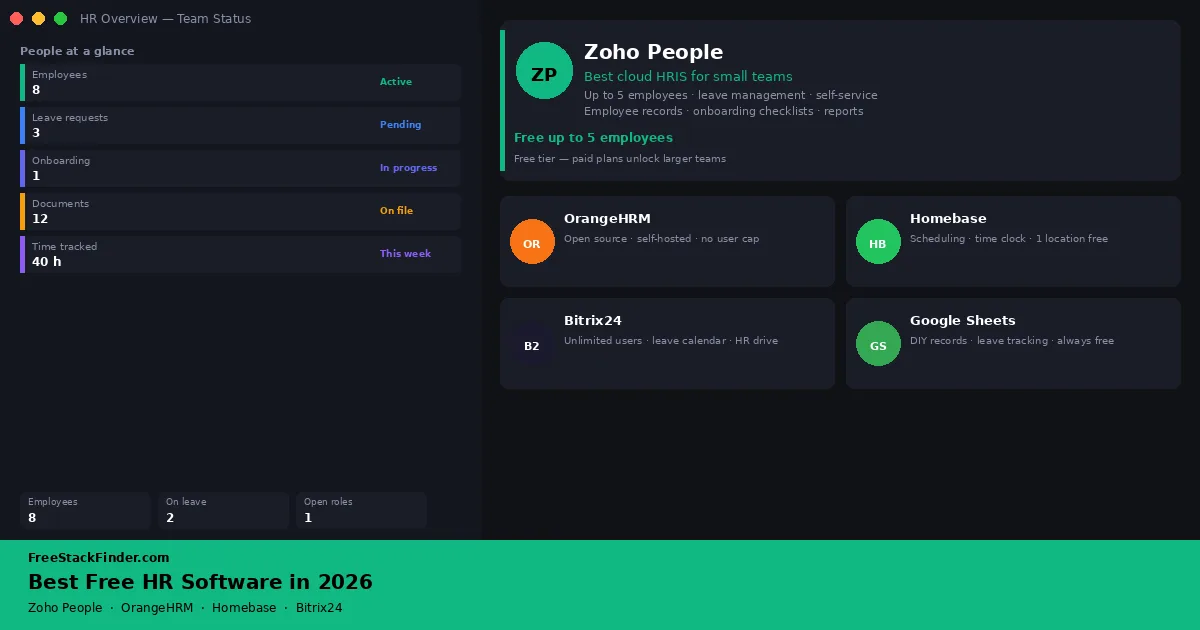
Zoho People is a cloud-based HRIS from Zoho covering employee records, leave management, self-service portals, and basic onboarding workflows.
Zoho People covers the first layer of employee administration:
- Up to 5 employees
- Employee self-service (profile, documents, leave requests)
- Leave and attendance management
- Basic reports
- Onboarding checklists
The ceiling is clear:
- Payroll (not included in any Zoho People tier by default: requires Zoho Payroll, which is a separate product)
- Performance management
- Advanced workflows and automations
- More than 5 employees
Use Zoho People for a founder’s first few hires, especially when employee records and leave requests need to move out of email or spreadsheets. It is not the right fit if payroll or performance reviews are the core requirement.
Zoho People’s free plan is a genuine HRIS rather than a demo. Leave management, employee records, and basic onboarding workflows are functional on the free tier. The 5-employee cap is a hard limit, so teams close to that threshold should plan the paid path before moving everything in.
2. OrangeHRM Community Edition
OrangeHRM Community Edition is an open-source HRIS that you self-host. The Community Edition covers employee records, leave management, time and attendance, performance reviews, and recruitment basics.
OrangeHRM Community Edition gives self-hosted teams a full HRIS base:
- Unlimited employees (self-hosted)
- Employee information management
- Leave and time-off tracking
- Time and attendance module
- Performance management
- Recruitment module
- Open-source license (GPL)
The trade-off is ownership of the stack:
- Cloud hosting (you provide the server)
- Support (community forums only; paid support is a separate offering)
- Some advanced modules available only in the commercial editions
Choose OrangeHRM if your team can manage a server and wants employee records, leave, time, recruitment, and performance modules without per-employee pricing.
OrangeHRM removes the user cap entirely for self-hosted installs. For a business that can manage a PHP/MySQL stack, it is the most complete free HRIS here. The cost is hosting overhead and the absence of official support on the free tier.
3. Homebase
Homebase is a scheduling, time tracking, and team communication tool designed for hourly and shift-based workforces. Not a full HRIS, but useful for the operational side of people management.
Homebase is scheduling-first:
- 1 location, unlimited employees
- Employee scheduling
- Time clock and time tracking
- Team messaging
- Timesheet management
- Basic hiring tools (job posting to limited boards)
It is not a complete HRIS:
- Multiple locations
- Payroll (requires a paid plan or integration)
- Performance management
- Advanced HR documents and compliance tools
- PTO tracking with approval workflows (limited on free tier)
Use Homebase for restaurants, retail, service businesses, or any team where the immediate pain is “who is working when” rather than formal HR records.
Its free plan covers scheduling and time tracking for one location with no employee cap, which is broader than most free HR tools. It is not a substitute for an HRIS if employee records, documents, or leave workflows are the real problem.
4. Bitrix24
Bitrix24 is a broad free workspace that includes CRM, project management, communication, and a set of HR-adjacent features: employee directory, absence calendar, time tracking, and basic onboarding.
Bitrix24 wraps basic HR tasks into a larger workspace:
- Unlimited users
- Employee directory and profiles
- Absence calendar (leave requests and approvals)
- Time tracking
- Task management
- Internal messaging and video calls
- HR drive (shared documents)
The HR layer is broad rather than deep:
- Payroll
- Formal performance review workflows
- Advanced HR automation
- Dedicated HR reporting
It fits teams that already use Bitrix24 for communication, CRM, or project management and want basic employee directories, absences, and documents in the same workspace.
The free plan has no user cap, which is unusual. The trade-off is that the HR module is broader than deep: leave tracking works, but it is not as structured as a dedicated HRIS.
For teams already using Bitrix24’s free CRM tools, adding the HR module requires no extra setup.
5. Google Sheets (or Excel Online)
Google Sheets and Excel for the web are spreadsheets rather than HR systems. They can still hold a basic employee directory, leave record, or onboarding checklist for a small team.
The free plan is simply the spreadsheet tier you already have: Google Sheets and Microsoft Excel Online both cover rows, sharing, commenting, and basic automation.
What it lacks is the HR structure: leave request workflows, employee self-service, audit trails, permission controls on individual records, onboarding automation, and anything that a purpose-built HRIS provides.
Use a spreadsheet only for solo operators or two-person teams that need a structured place to store employee details, track leave, or document onboarding and are not ready to adopt dedicated software.
The appeal is zero cost, zero setup, and familiarity. A well-structured spreadsheet covers basic leave tracking and employee records for very small operations. Once a team grows past three or four people, maintaining accuracy in a spreadsheet becomes a real risk.
For spreadsheet tool options beyond Google Sheets, see free spreadsheet alternatives.
Compare hosting, team limits, and focus
| Tool | Free employee limit | Leave tracking | Self-service | Time tracking | Onboarding | Notes |
|---|---|---|---|---|---|---|
| Zoho People | 5 | Yes | Yes | Basic | Checklists | Best cloud HRIS on free |
| OrangeHRM CE | Unlimited (self-hosted) | Yes | Yes | Yes | Yes | Requires own server |
| Homebase | Unlimited (1 location) | Limited | No | Yes | No | Scheduling-first |
| Bitrix24 | Unlimited | Basic | Partial | Yes | Basic | HR as part of workspace |
| Google Sheets | N/A | Manual | No | Manual | Manual | DIY only |
Free works until records need automation
Free HR software works well when:
- Your team has fewer than 10 people
- You need basic leave tracking, employee records, and onboarding checklists
- You do not need payroll, compliance workflows, or advanced reporting
- You are testing what HR tooling you need before buying
Consider a paid plan when:
- You need integrated payroll
- You have employees in multiple countries or need country-specific compliance features
- You need formal performance review cycles with scoring and feedback workflows
- Your team has outgrown the free-tier user or location caps
- You need audit trails for employment documents or disciplinary records
A note on payroll: None of the free plans above include payroll processing. Payroll, especially across jurisdictions, carries tax and compliance obligations that free-tier software does not address. If payroll is a requirement, evaluate dedicated payroll tools separately rather than relying on HR software free plans to include it.
A note on compliance: HR software organizes records and workflows. It does not provide employment law advice, and free plans in particular do not include compliance features designed for specific regions or industries. If compliance requirements are a priority for your team, evaluate tools with dedicated compliance support.
Build around the missing HR workflow
For most small teams, the choice is straightforward:
- Under 5 employees in one location → start with Zoho People for a proper HRIS structure
- Shift-based or hourly team → start with Homebase for scheduling and time tracking
- Self-hosting is an option and you want no user cap → use OrangeHRM Community Edition
- You already use Bitrix24 → activate its HR features rather than adding another tool
Google Sheets remains a valid starting point for very small operations, but it does not scale. The first time a leave dispute or a missing employment document becomes a real problem, a structured HRIS earns its setup time immediately.
If you are evaluating tools alongside HR software, see the guides on free invoicing software and free accounting software.